The Power in Knowledge - It Travels: Martial Arts Lessons, Opera and Beyond
Knowledge travels.
And that’s a good thing.
Because with the right knowledge, you can change just about anything, especially when it comes to your mind and body.
And yet, the way knowledge travels greatly influences whether, and when, we absorb it, and how we can, or can’t, make use of it.
We’ve all probably been there: you’re trying to learn some movement skill, a dance step, a yoga pose, a martial arts form, a circus trick, and you start to feel overwhelmed, insecure, thinking you’ll never get it, and questioning yourself. And you’ve probably had the opposite experience too, when you’re right on the edge of learning something new, and you’re feeling: curious, excited, and confident that you’re about to get it.
What this shows us is that the process of transferring knowledge has a feeling state, a lived experience we inhabit as it happens. If we could look inside an external drive as it absorbs information from a computer, we might see 1s and 0s moving between pieces of technology. But in human experience, when knowledge travels, we feel it. We have emotions, mental images, and physical sensations.
Good movement teachers understand this. Even so, while simple in concept, few movement classes actually achieve it. A great teacher lets knowledge travel by offering just enough information, at a pace that pushes students but doesn’t drown them. Go too fast. Cover too much. And the students get lost.
The psychoanalyst Donald Winnicott called this state of development “good enough mothering”, holding the learner just at the edge of their capacity, so they can wobble, fail, and still grow. Winnicott knew that skill and understanding were impacted by the environment in which they were held.
Sugata Mitra, a computer science professor from India, also saw environment as key to learning.
In this amazing Ted Talk, Mitra explains why he views learning as something that emerges when the right conditions are created.
And he also recognizes that knowledge travels.
Mitra points out that the modern education system in the USA, UK, and India was built for a particular place and time, the rise of the British empire, when knowledge traveled mainly by ships.
Today, knowledge travels very differently from the days of giant sailing vessels. Not only does it travel through our minds, but it also travels through cables, wires, and in clouds.
But the process of transferring knowledge remains a lived experience we inhabit as it happens, even though it has changed and varied with time and culture.
For example, those living through a particularly tumultuous time in the political and national experience of China had a unique experience as part of their history.
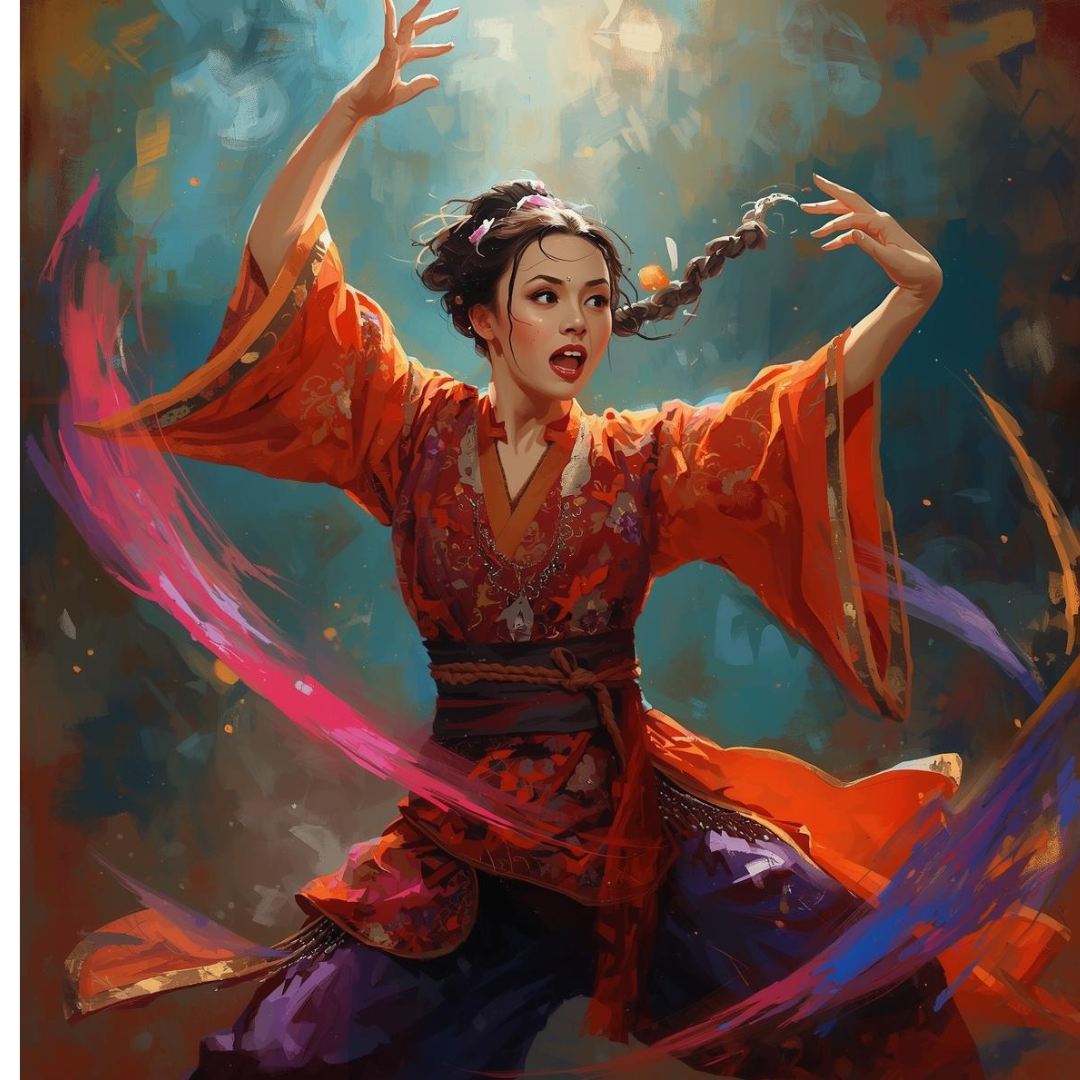
The Red Boat Opera
The Red Boat Opera was a traveling Cantonese opera troupe in southern China, mainly Guangdong, during the mid-to-late Qing dynasty, roughly the 18th to 19th century. They performed on painted red boats traveling along rivers, hence the name. It’s thought the martial art Wing Chun owes something to their practices.
(Unbeknownst to many, there is a direct link between the performing arts and martial arts.
Bruce Lee, one of the best-known martial artists, first learned martial arts from his father, who was performing in the opera. Remember the name is : Martial art!)
So it’s little surprise to learn that the Red Boat Opera troupe members weren’t just performers.
Many of these troupes were actually covers for the transfer of martial skills and information between rebel networks.
Because the Qing government kept a close eye on formal martial schools, these opera troupes, having what appeared to be a legitimate and non-threatening reason to train in fighting, weapons, and choreography, became a perfect cover for hiding fighters, moving weapons, and passing information, all disguised as performance.
This evolution is similar to what some scholars believe were influential origins of the practice of yoga, which may also have been a way for a native population to train military skills found undesirable by the ruling government, under the cover of movement and exercise practices.
Not only did the Red Boat Opera make its members skilled in performance, but in fighting as well. And their knowledge traveled, both between members and, literally, around the country.
Because knowledge travels between people, centralizing knowledge can be a detriment.
For example, one of the weaknesses of modern yoga teaching is the overreliance on lecture as a teaching tool.
Imagine a yoga class with an Olympic athlete, a neurosurgeon, and a physical therapist in the room, and only the yoga teacher speaks. How much information about the body is lost? How much insight that might emerge never does?
Similarly, movement classes that are rigidly standardized limit the exchange of knowledge, whether it’s in: boxing, dance, weight lifting, or any other movement modality.
Today, we still fail when all the knowledge stays with one teacher, one guru, one oracle. We lose richness and flow when we centralize knowledge.
This is what Sugata Mitra pointed out: that centralizing knowledge during the Victorian era, making it something that was controlled by the empire, created an education system that often cut learning off from the very nature of learning itself.
And today, because we have access to the internet and can store information in the cloud, we must think about how knowledge travels, not only electronically, but also in how we structure our classes, our conversations, and our teaching.
What we need, like in those historical practices, is a distributed, collective experience, many voices, many perspectives, so that the learner’s internal growth is supported by a whole web of shared insight.
Good teaching is not about hoarding knowledge. It’s about moving it, between people, between bodies, between situations, so it can keep traveling.
Let knowledge move as freely as the Red Boat Opera carried skill and strategy across a continent, and it thrives. Give it in digestible pieces, and it lights people up from the inside. Try to control it, centralize it, or make it a rigid template, and much of what knowledge can build is lost.