Controversy and Conflict in Breakthrough Ideas
One value of disagreement is that it surfaces information rather than suppressing it.
Experiences that include: friction, mess, disagreement, discomfort, and even opposition can sometimes be the necessary environment in which greater truths are revealed, and better and more effective ways of living become possible.
Life holds real ambiguity and that’s okay, but when ambiguity is actually used as a substitute for accuracy, or a cover for lies, it can cause real problems.
To solve the many challenges human beings face, it’s important to avoid the prison of “the one right way.”
Mental flexibility is key.

Dr. Kodi Azari was one of the surgeons involved in the earliest American hand transplants in the United States.
This included the first double-hand and double-arm transplants
In 2011, Dr. Azari led UCLA's first hand transplant. This was the first on the West Coast.
A 14-hour operation involving a 17-person surgical team.
He watched in real time as a procedure that had been dismissed as:
too radical,
too dangerous,
and too uncertain
became the foundation of what would be a stunning addition to medicine.
In 2010, Azari, who had recently moved to Los Angeles, had flown back to Pittsburgh on the red-eye specifically to perform a double-hand transplant.
For this procedure there were:
13 surgeons scheduled to begin simultaneously
8 additional surgeons ready to substitute
4 operating tables
donor limbs arriving from West Virginia in a cooler packed with ice
teams of surgeons working simultaneously on bones, nerves, arteries, veins, muscles and tendons.
I once heard him tell a story about the early days of transplantation and the surgeon Thomas Starzl, who pioneered liver transplants.
Starzl's early liver transplantation was an especially vivid example of an idea that looked almost indefensible while it was being developed, and eventually became routine.
In the early years, Starzl's operations used so much blood (up to 1,000 units) that other hospitals could not perform elective surgery because there was very little blood left in the city.
Patients died during the operations or in the weeks afterward.
Hospital administrators, the public, and the media questioned why he continued performing a procedure that seemed so dangerous, costly, and unsuccessful.
But Starzl believed the operation could be made to work.
He kept going.
Today, liver transplantation is an established medical procedure, performed routinely in hospitals around the world.
The patients who receive them, and the doctors who perform them, do not think these procedures are a waste of time, or that they are too dangerous, nor are such procedures as messy or resource intensive as they were in the old days.
Excellence is the refinement of imperfect attempts.
Today many people find great benefit in what once was a big controversy and conflict.
Much of the same was true for the nine experimental kidney transplants attempted between 1951 and 1953.
Most failed.
Several kidneys functioned only briefly, although one functioned for about five and a half months before rejection.
Contemporary physicians largely regarded these attempts as demonstrating the futility, and in some cases the ethical questionable-ness, of human kidney transplantation.

There’s certainly no shortage of controversy and conflict in the world today.
And if you’re anything like me, you don’t relish more of it, and try to hide away from triggering such discussions and save your energy for other things.
It’s understandable.
Who really enjoys conflict and controversy?
It can feel incredibly difficult to contend with the differing perspectives, reactions and emotions that come up for people.
The more I’ve learned about how people react emotionally, the more i see how the wide disparity of life experiences predispose people to feel differently about many things.
In everything from yoga, to strength training to acting to medicine and beyond people have very strong feelings about a host of issues.
Over time you learn it’s far easier to stay quiet and not trigger anyone or risk conflict and controversy.
But the other day I said to heck with that and finally made a bit of a fuss about something that bothered me: how often I run into lies (or ambiguity that seems to indicate the possibility of lies).
What the experience showed me is that there is tremendous health to be found in the integration of differences.
What starts off as messy and conflictual can lead to very useful refinements, new understandings and better ways of approaching life.
The idea in the practice of Nonviolent Communication that too often our emotions prevent us from seeing a wide range of possible interpretations of circumstances, and hence better solutions, turns out to be pretty on the money.
Alongside that it’s important to remember that external circumstances have a reality beyond feelings.
Can a liver transplant be done successfully?
There were many feelings about it.
But clearly many external factors, and one correct answer, which we know today.
Our bodies are phenomenal real time events.
And it’s a good thing the liver works differently than the kidney, the brain or the heart.
Each organ has different needs, jobs, resource demands, contributions and abilities.
Yet, working together they create one of the most complex and majestic phenomena in the known universe.
Both the body and organ transplants show us what an amazing outcome we can achieve when we allow for some mess, conflict and differing perspectives.

Day to day however the value of conflict and different perspectives can be difficult to keep in mind.
After all, who gets up every day thinking: my body is one of the most majestic phenomena in the known universe?
Or, alternatively, Gosh, today I’m really looking forward to some healthy conflict.
Conflict is inevitable in the pursuit of learning and new, breakthrough ideas.
Lke the sensation one feels sometimes when lifting weights, the discomfort can be viewed as something thatproduces health.
Not every conflict.
It depends on how you do it.
But then again you can’t lift weights any old way and get benefit, you have to do it with some skill.
But that doesn’t’ mean the force exerted and using real strength and effort is always bad.

The theologian Robert Cummings Neville once said:
“The real problem is god’s creation is too rich to be reduced to narratives.”
I’d say:
The real problem is not understanding deeply how something works
Or more fully:
The problem is that not understanding deeply how something works - or the actual reason(s) it’s broken - and if so why - alongside the feeling that it’s unimportant to check - or to communicate that information clearly and prominently - is not a feedback system that ensures high levels of accuracy.
It increases the chance of mistakes, miscommunication and deception.

A while back I shared with a group an experience I had with a car repair.
To my mind, aspects of the experience involved either a degree of carelessness or a lack of full transparency.
And maybe pieces of both (for different reasons.)
As is often the case it was difficult to tell 100% for sure if I had been lied to.
That, by itself, is a particular kind of problem. And has a feel to it.
Whatever the truth, I was left with the feeling that it had been quite difficult to know what exactly had gone on.
And that made little sense as this was not organ transplantation.
This was a very simple mechanical fix.
One I could have possibly done myself.
One I had seen pieces of done on YouTube.
But since it would require opening the door panel of the car, something that has many steps I wanted pay a professional to do it, ostensibly because it would be far easier for them.
For a repair shop this was not some complex matter, and took about an hour.
And yet, a whole air of tension and ambiguity surrounded the entire experience.
It should have been and is simple to say:
1) this is what is broken (or not broken)
2) this is what is needed
3) here’s what it costs
Regrettably, once the door panel was open, the shop did not get in touch prior to the repair to communicate what specifically was broken.
In fact, they insisted on ordering an expensive new part before they even had diagnosed the issue.
As it turned out, inside the car a screw was missing but they never answered the question whether that screw could be replaced for $2 and the cost of labor.
I never would have known what happened except for the fact that I followed up, and got the old part.
It sits here beside me, and I still don’t know if it’s actually broken.
Maybe I will take it to another mechanic and find out.

This experience itself, was not so much the issue as the fact that it was “the straw that broke the camel's back.”
It brought back the many times “ambiguity” really hid a severe failure in either transparency or careful attention to important issues.
And quite frankly it brought up in me a revulsion in the number of times in my life I’ve encountered lying and carelessness.
It was just one time too many where things were “ambiguous” that didn’t have to be.
Not at all.
So, to make a long story short, I was upset.
While the world holds intelligence, kindness, competence, loyalty, and genuine care, there is also indifference, incompetence, self-interest, dishonesty, neglect, and enormous amounts of people simply doing what is easiest for them.
And I was just sick and tired of running into the latter.
In many situations you often can't tell whether you're looking at deliberate deception, incompetence, carelessness, self-interest, poor communication, institutional habit, or some combination.
Yet they all can produce the same result: you don't know what is actually true.
A society can become profoundly unhealthy when dishonesty, evasion, self-interest, and appearance-management repeatedly produce better rewards than truthfulness, accuracy, accountability, and genuine care.
If you want better answers, you need systems in which people are allowed to surface disagreement, uncertainty, mistakes, strong reactions, inconvenient information, and competing interpretations, and then actually work with that material rather than suppressing it.

One thing I’ve come to see is that just as you can’t sit around and never do any movement and expect your body to be strong and mobile, you also can’t expect to endure “the slings and arrows of outrageous fortune” (as William Shakespeare put it) and not have some process to metabolize those experiences.
Whether it’s exercise, meditation, a close knit group of friends.
Our bodies need to digest our food to get value from it.
And our minds need to digest our experiences to get value from them.
The things many of us want like peace, ease and insight into solutions for the problems we face come from a process.
Just like physical strength comes from a process.
You have to do something.
If you skip the process and try to make things easy all the time, you lose the very solutions and outcomes you desire.
Making liver transplants work wasn’t easy.
What we often miss is that we need a space for this process, a discussion group, a family, a partner, a religious community, or what have you.
Otherwise the ambiguity can’t be converted into progress and more effective and better ways of doing things.
You see, the problem with lies is that they make it hard to keep clear in your own mind what is true.
Like the fog of war, they inject the fog of ambiguity.
Lies often show up as ambiguity.
But even when the ambiguity is just confusion or lack of accuracy, even that, when combined with harsh criticism in the face of a different view, can destroy nuance, accuracy and progress.
Can a kidney transplant be done effectively?
Is that possible?
Today there’s a distinct answer to that question independent of thoughts and opinions.
Too often feelings, opinions and agendas are stronger than the desire to know what is happening, or can happen, in reality.

While I don't expect life or people to be perfect, in this case, one of the things that bothered me is how often we get focused on feelings and stratagems rather than the underlying reality.
The metal and plastic piece that came out of my car has a reality independent of anyone’s perception or feeling.
Any engineering student, smart science fair winner in high school or competent mechanic could say: “Yes this is broken. Or, no, this just needs a screw and can be used for years to come.”
It’s trying to find that reality that is important to me.
If Thomas Starzl believed he could figure out how to transplant a liver into a human being, I think I can figure out what’s really going on in a car repair.
Too often in life, many things like financial incentives, emotions, human frailties, and all the rest interfere with accuracy.
And many people prefer not to know.
I mean, really, who wants to try to figure out organ transplantation?
Fortunately for me, there was a process and a place for me to give voice to the frustration, sadness and anger at having consistently come up against an ambiguity that is the result of people and systems that, for whatever reasons, and in whatever moments, do not operate in straightforward ways.
I did this in a discussion group.
The practice of Nonviolent Communication has many guidelines, but one of them is to try to communicate from honest expression.
This is more than just saying what is really happening, but trying to connect to the energy of the feelings inside of you when you are speaking.
This exists on a spectrum, of course, and is balanced by other guidelines, but is a central piece of the practice.
Too often people conceal and hide information that is important to solving an issue, so that it’s a bit like trying to finish a puzzle when pieces are still in the box.

What came from my sharing was a myriad of reactions.
Some people felt an increased sense of trust and saw new possibilities for how they themselves might experiment with self expression.
Some people were very happy with the level of clarity that I brought to the issue and felt it helped them organize their own thinking.
And some felt that the expression was not as concise or as useful to them as they might have wished.
There wasn’t one reaction.
And there wasn’t one right reaction.
But from the sharing came a number of healthy discussions, and quite a bit of learning, albeit not 100 percent agreement or satisfaction.
Whatever the reactions, honest expression creates new information.
Though I have for some time known it intellectually, this was a confirmation for me that any time we speak about an issue it will have real benefit to some people and not be right for others.
Some people will like what we say and resonate with it.
And some won’t.
However, the two things are generally linked.
If you don’t speak and share you will avoid anyone’s displeasure.
And at the same time:
All of the learning and benefit that comes from what you might share will be lost.
One of the things that came from the discussion I stimulated was a focus on rigor, accuracy and the values it takes to walk a lonely journey toward a new, breakthrough idea.
Most people didn’t know or care whether organs could be replaced.
And most people hand their car over to the mechanic and just pay whatever is asked without ever deeply understanding the underlying issue.
We would think that people who double check, champion accuracy, and try hard to serve people well would be rewarded, unfortunately it’s not often that way.
In retrospect people often concede that something was accurate.
But at the time it’s often that interests align against ideas that conflict with the way things work most easily and commonly.
Having seen hundreds of people building businesses, I can say that:
A market can reward things that are different from actually solving the problem.
A system doesn't necessarily have to contain malicious people to produce bad outcomes.
It can simply reward what is easiest to sell, easiest to deliver, easiest to explain, easiest to bill, or easiest to scale rather than what actually works.
Try explaining a liver transplant to someone and sell that in the early years.
Someone can be very good at solving a problem and still struggle to show that it works.
And once they try to scale, they may have to change the solution into something that's easier to sell and deliver at scale, not necessarily something that works as well.
So when you encounter a successful product or business, don't automatically assume its success proves that it's the best solution.
It might be hard to imagine a world where the pioneering work had never happened.
Especially in a niche.
We all probably intuitively know life would be more challenging if penicillin and other antibiotics had never been discovered
But do we really visualize the cost of a world where no one has the courage to blaze the trails of transplantation?
I get to see niche things in mind body practices quite a lot.
And here’s an example from the world of yoga.
A system can become constrained by its own success and tradition.
Bikram Yoga itself was originally an adaptation. Bishnu Charan Ghosh developed an approach, Bikram, who was both a knowledgeable innovator and physically strong individual, adapted it for a different population, and it became successful. But it also became increasingly rigid in its approach to yoga postures.
What happens when innovation and adaptation is shut down?
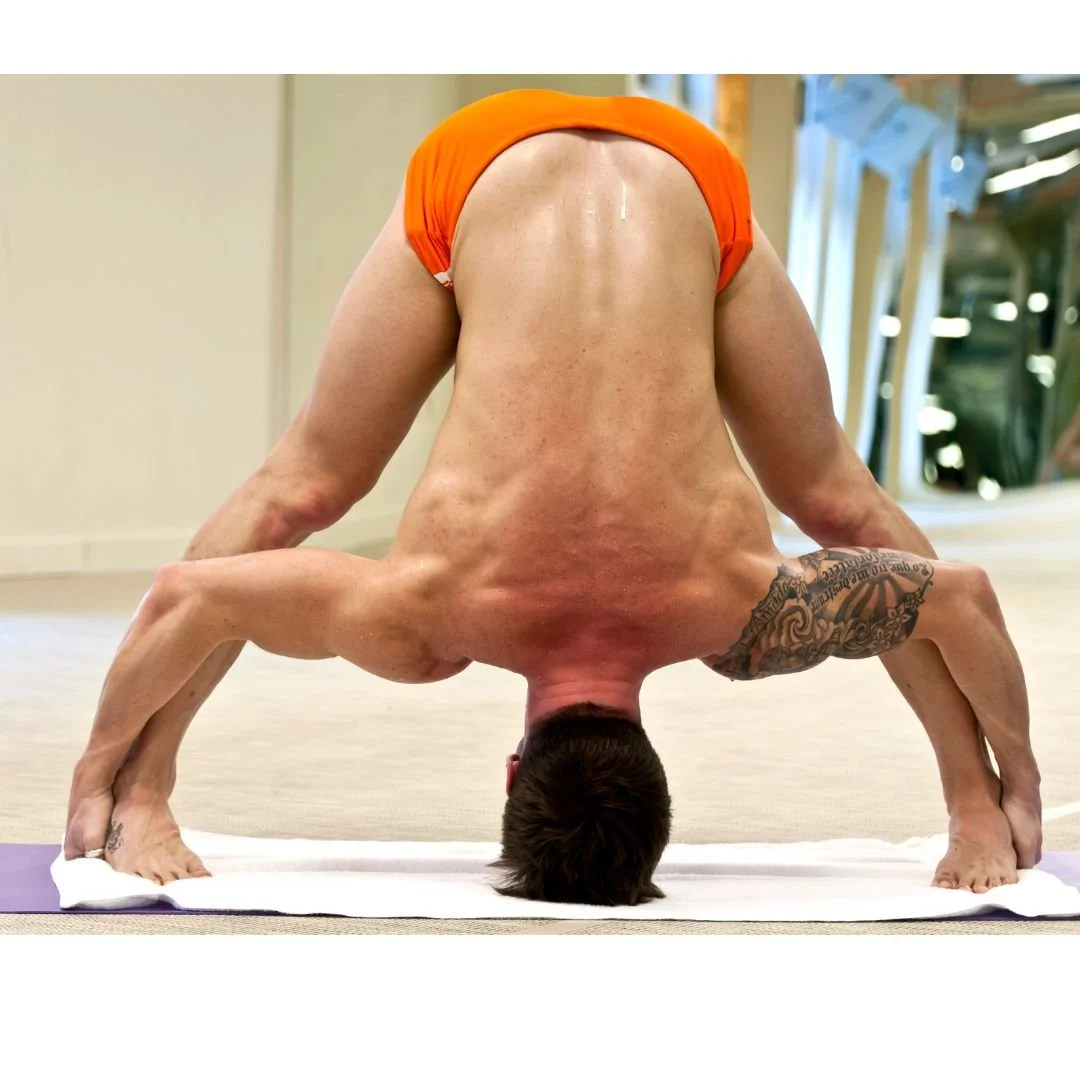
Bikram yoga is a style of yoga that is performed in a heated room.
Furthermore, yoga is often quite different in India from the postural practice best known in the USA. It can look like anything from a spiritual practice to something more akin to a visit to the chiropractor or acupuncturist.
The origins of Bikram yoga go back to the middle of the 20th century, in Kolkata, India where a yoga and exercise teacher named Bishnu Charan Ghosh, developed a system where sick or injured clients were assigned specific yoga poses along with weight lifting to help with ailments.
He used to say that these techniques were the keys to the kingdom of good health.
According to Jimmy Barkan, one of Bikram Choudhury's earliest students and later the founder of his own yoga method, Choudhury adapted the postures for American students (and bodies), dropped the weight lifting.
He also added heated rooms, taking into account his observation of his students in Japan using saunas during breaks.
If you’ve ever taken a “hot yoga” class it comes, in part, from this history.
I’ve taught and practiced the Bikram style of yoga (sometimes called Hot 26, for the 26 poses it includes) extensively.
There are many benefits to the practice and it has a lot of useful insights and techniques.
What is less good, in my opinion, is the way it has inherited a “bootcamp” approach from its founder, and the failure to recognize the limits of a lecture style of teaching.
Due to this, in some places and spaces, some teachers can become adamant about the right way to do the Bikram practice (or poses).
The problem is, of course, the Bikram way is an abstraction.
It’s a tradition.
Or in yoga terms a lineage.
But the human body does not recognize yoga lineages when it moves.
The body is the reality-testing mechanism.
Not the idea, the opinion, the outlook, the belief or the group.
Bones, tendons and ligaments don’t say: “Oh, we’re doing this the Bikram way.”
Range of motion in joints is not impacted by the Bikram way, the Ashtanga way or the Kundalini way.
The body does what the body does.
And there are MANY ways to understand that and think about it.
And as one is exposed to MANY approaches to working with the body, one comes to see and understand more about the benefits and limits of any one approach.
For example, one of the things that yoga series do well, that many people, including yoga teachers, don’t always think deeply about, is that they force people to stand on one leg.
Why would that be valuable?
Well much of our locomotion happens by placing weight into one leg, and then taking it off of the other, as in running or walking.
Because the body has to shift and adjust while balancing on one leg, overloading this ability, or what is often called Single Leg Training is a useful way to build ability and strength in athletes and non athletes.
Yoga is a body based form of single leg training when it does what are called “balancing postures.
One specific single leg posture used in yoga has several names for the same thing:
Dancers Pose (in English)
Standing Bow Pose (in English)
Natarajasana (Sanskrit name in non-bikram yoga)
Dandayamana Dhanurasana (Sanskrit name in Bikram)
Whatever the name it looks something like this:
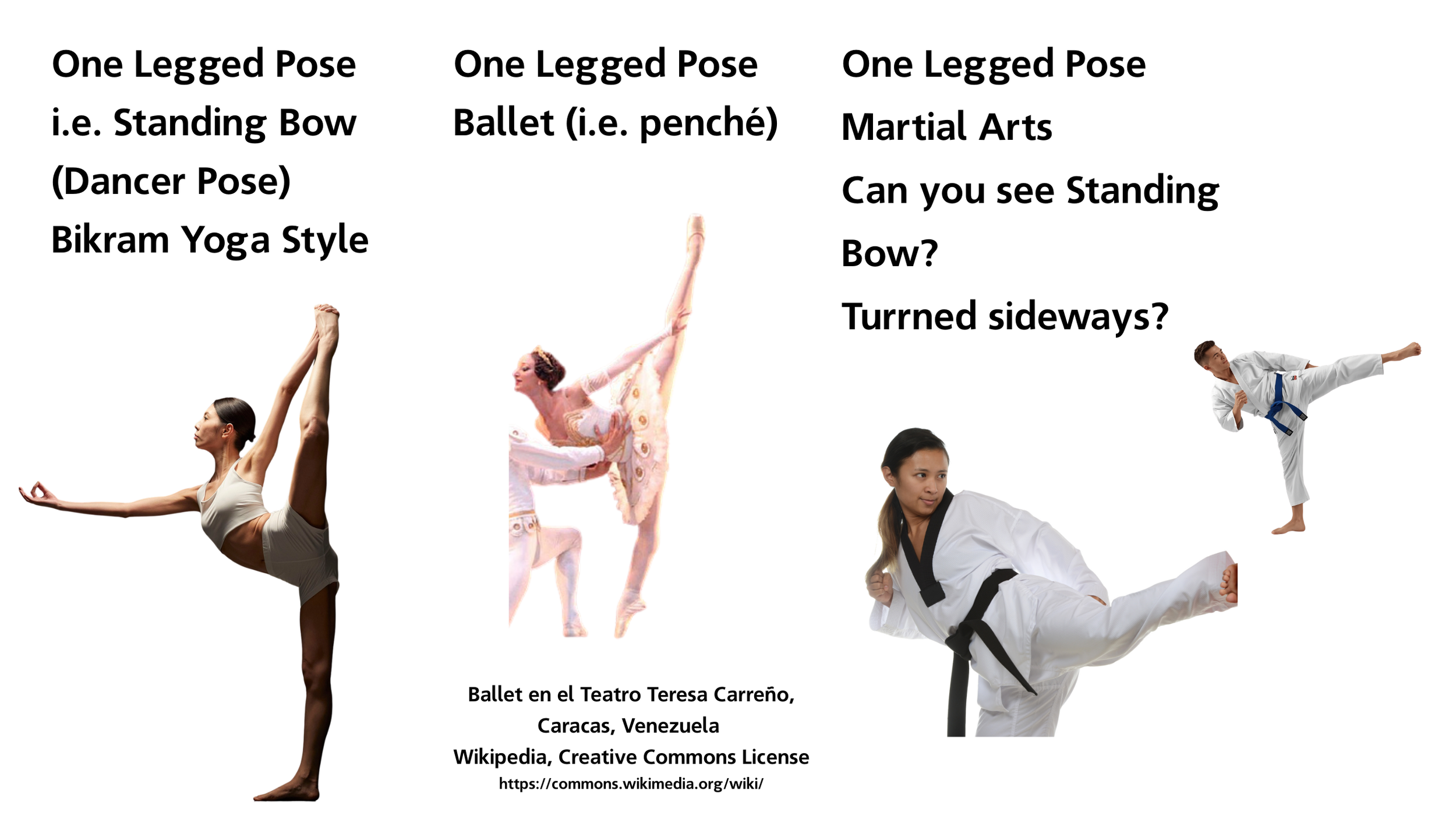
The Bikram series has a very specific way of getting students to do this one legged position which I’ll call Dancer’s Pose (and more correctly in Bikram is Dandayamana Dhanurasana).
And while this works for some people. It doesn’t work for many others.
Not only that, while the logic behind the approach may be relatively sound, teaching and coaching is never just about the logic.
It’s about how it is applied.
What the student understands.
How the learning is scheduled and arranged.
Go to a Bikram class and you can see for yourself what percentage of the people in the room can do the posture as shown in the photo.
Bikram teachers may not necessarily have had focus in Single Legged Training outside of yoga, or an understanding of how single-leg stances are used in other modalities, like Ballet, Martial Arts, or Gait Training in physical therapy.
Or if they do have that training, the requirements of the Bikram style may leave little room to use it, as the style often requires adherence to a rigid script (though Mr. Barkan shares that Bikram himself often departed from the script).
The end result?
One could argue that for over 50 years, a different way of investigating, looking at and attempting this yoga pose has been shut out of the Bikram ecosystem.
Now apply that to organ transplants.
There is a very conceivable reality where, but for a few pioneers, a bunch of conflict and controversy, we never would have learned to transplant a kidney or a liver.
New and different knowledge is shut down and shut out every day.
The fact is some people benefit from liver and kidney transplants.
And many people will benefit from approaching a one legged pose like Dandaymana Dhanurasana (Dancer’s Pose or Standing Bow) in a way that is quite different from the Bikram approach.
And when that knowledge is shut down, and shut out, and different opinions and ideas, insights and approaches can not be raised, people get less effective outcomes and less understanding.
Without conflict and controversy, new and better and more effective ways of doing things are lost.
There is a whole way of approaching the same yoga pose, and accommodating different bodies (the very spirit of what Bikram himself did at the start) that has nothing to do with yoga.
You can find your way to it from the martial arts, through flexibility training, or from the techniques a ballet dancer uses to lift her leg up to the side of her head.
The ability to work with the body is not limited to one technique, modality or group.
But it breaks my heart to see rooms full of people, and the community at large, stay lost in the prison of the one right way.
As my father, a retired physician once said: If there was one right way, everyone would be doing it.
And as the history of medicine itself shows us, the way that seems implausible, risky and outlandish is sometimes, even correct.
Disclaimer
The information and content provided by Mind Body Literacy and in this article is general information and is intended for educational purposes only. Individual situations vary. This content is not intended as, nor should it be used as a substitute for, professional medical or psychological advice, diagnosis or treatment. No guarantee or warranties are made with respect to the accuracy, applicability, fitness, or completeness of the content.
Nathan Schechter, ACSM CPT, writes about the mechanics of experience - how people learn, change, connect, and perform under real conditions.